
Agritech
MYCENTRE4IR ESG INNOVATION CHALLENGE SPOTLIGHT SERIES
Pacton Technologies × REDtone Digital Berhad
From Pilot to 500 Farms Across Malaysia & Indonesia
Submitted by: Pacton Technologies Sdn Bhd (Co. No. 1297679-A)
Corporate Partner: REDtone Digital Berhad
Programme: MYCentre4IR ESG Innovation Challenge 2024 (Winner) — a joint initiative of MYCentre4IR (hosted by MyDIGITAL Corporation) and Bursa Malaysia Berhad, powered by UpLink (World Economic Forum)
1. Sector Overview
2. Project Overview
3. Challenges
5. Why This Matters
Pacton Technologies × REDtone Digital Berhad
From Pilot to 500 Farms Across Malaysia & Indonesia
Submitted by: Pacton Technologies Sdn Bhd (Co. No. 1297679-A)
Corporate Partner: REDtone Digital Berhad
Programme: MYCentre4IR ESG Innovation Challenge 2024 (Winner) — a joint initiative of MYCentre4IR (hosted by MyDIGITAL Corporation) and Bursa Malaysia Berhad, powered by UpLink (World Economic Forum)
1. Sector Overview
Aquaculture has become the world's fastest-growing food production sector, having overtaken capture fisheries as the primary source of farmed fish protein. In Malaysia, the industry supplies the majority of the animal protein consumed each year, generates billions of ringgit in export revenue, underwrites the livelihoods of more than 100,000 smallholder farmers, processors and downstream operators. The 13th Malaysia Plan (RMK-13) and the National Agrofood Policy 2.0 (NAP 2.0) both designate aquaculture as a strategic pillar for food security, rural income and ASEAN export competitiveness.
The sector, however, is under structural pressure on three fronts simultaneously. Feed costs historically constitute 60 to 70 percent of farm operating expenses and have risen sharply since 2022, compressing already slim margins. Meanwhile, disease outbreaks routinely wipe out 30 to 50 percent of shrimp pond yields across Southeast Asia, with White Spot Syndrome Virus and Early Mortality Syndrome being the most destructive. Furthermore, ESG and traceability requirements imposed by EU, US and Japanese importers are tightening faster than smallholders can comply with. The EU IUU (Illegal, Unreported and Unregulated) regulation, the US Seafood Import Monitoring Programme and Japan's chain-of-custody frameworks require digital primary data that paper-based farms cannot produce.
Three structural trends are converging in response: (i) a shift toward computer-vision AI as the dominant data-capture layer (ii), replacing fragile sensor networks in tropical conditions; the move from desktop dashboards to WhatsApp and smartphone-native interfaces that smallholders can actually operate; (iii) and a growing sovereign-data posture across ASEAN governments, which are increasingly unwilling to allow farm-level biological data flow unchecked into foreign cloud platforms.
This is the operating environment in which the Pacton–REDtone collaboration was designed.
2. Project Overview
Pacton Technologies Sdn Bhd, a Kuala Lumpur-headquartered AI-IoT company, was paired with REDtone Digital Berhad — a Bursa-listed telecommunications and IoT solutions provider whose IOT division operates rural and industrial connectivity infrastructure across Malaysia. The fit was structural. Aquaculture's ESG transformation is fundamentally a data problem, and data collection from the pond requires both AI software and rural-grade connectivity. Pacton supplied the FishSpeak platform; while REDtone supplied the corporate validation backbone.
Pacton's journey to FishSpeak was far from linear. Between 2021 and 2024, the company deployed conventional water quality sensors to approximately 50 farms under the MDEC Digital Agriculture National Demonstration programme. Hardware maintenance costs placed pressure on margins, while the financial returns from smallholder deployments were insufficient to support long-term growth. The Challenge provided Pacton with both bridge funding and the institutional structure to redesign the system around a tighter sensor stack, a WhatsApp-native ERP bot, AI calibrated to mimic farm-specific operating conditions and a web dashboard.
The Challenge served three concrete functions. As a validation platform, the joint MYCentre4IR–Bursa Malaysia governance frame forced Pacton to articulate ESG outcomes in audit-grade language. As a network catalyst, the matching with REDtone Digital Berhad and the platform reach of MYCentre4IR, Bursa Malaysia, and Cradle Fund Sdn Bhd opened institutional doors that no Series A round could. As a capital signal, the RM 100,000 bridge funding co-disbursed by MYCentre4IR and Cradle Fund funded the proof-of-concept site end-to-end.
The proof-of-concept was deployed at a freshwater tilapia hatchery in Janda Baik, Pahang, over a five-month period in 2025. It produced the first defensible ESG outcome data from a Malaysian smallholder aquaculture site under a partnership with a listed company, and it became the platform on which everything that followed was built.
3. Challenges
The key question which the Challenge posed on the topic of ESG was specific and demanding: could ESG outcomes in Malaysian aquaculture be quantified in a manner robust enough to inform corporate sustainability disclosures and supply chain reporting requirements? Three structural barriers stood in the way of the solution to this problem.
Data does not exist where it needs to be. Most Malaysian fish and shrimp farms operate on paper logbooks, WhatsApp voice notes and farmer intuition. Feed conversion ratios are estimated rather than measured. Mortality is recorded in aggregate terms, often retrospectively. Water quality — temperature, dissolved oxygen, pH, salinity — is logged manually if at all. Without trustworthy primary data at the pond, no downstream ESG calculation can be justified in front of an auditor or an importer.
Rural connectivity is uneven, and the architecture must account for this. The Janda Baik site shares grid power with adjacent properties, requires power conditioning and depends on resilient cellular backhaul to keep an IoT-AI stack operational. Most off-the-shelf agritech assumes urban-grade reliability. Smallholder deployments do not have that luxury, and an architecture that fails on the first power dip never reaches the second production cycle — which is exactly where the corporate-grade connectivity capability of a partner like REDtone Digital Berhad becomes a critical factor.
The smallholder-digital literacy mismatch. Industrial aquaculture platforms built for large salmon operations in Norway, Chile and the Faroes assume farm sizes, capital intensity and digital literacy that are an order of magnitude above Malaysian smallholder conditions. Importing them is not a deployment problem; it is a fit problem. Smallholders do not operate dashboards as they usually prefer to communicate via WhatsApp.
Compounding all of this: legacy IoT solutions had already failed in tropical field conditions, the regulatory burden was rising under EU IUU and US SIMP (Seafood Import Monitoring Program) frameworks and financiers had no verified methodology for underwriting aquaculture against biological collateral.
4. Solutions
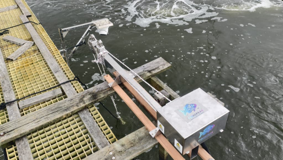
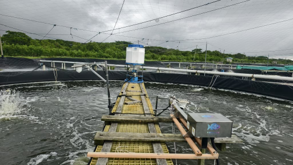
The Janda Baik pilot deployment combined four integrated layers into a single, smallholder-operable stack. At the hardware layer, the system comprised a seven-parameter stainless-steel sensor probe (dissolved oxygen, pH, Oxidation‑Reduction Potential or ORP, electrical conductivity, total dissolved solids, salinity, temperature), an 80kg solar-integrated smart feeder with flexible scheduling, a waterproof control box and a paddlewheel aerator. Connectivity and system reliability were supported by REDtone Digital Berhad’s IoT and 4G network infrastructure.
Meanwhile, at the AI layer, FishSpeak's models were calibrated to mimic farm-specific operating conditions. The system generated feed recommendations, dissolved-oxygen risk warnings and mortality alerts tailored to local farming patterns and environmental conditions. At the interface layer, farmers interacted with the platform through a WhatsApp-based ERP bot that provided real-time water quality information, AI-driven feed scheduling, mortality and sales logging, weather forecasts, remote feeder and aerator activation. At the governance layer, a web-based dashboard (www.fishspeak.live) enabled farm managers and auditors to monitor live sensor readings, track AI-generated alerts and maintain records for operational oversight and reporting purposes.
Performance was measured over a five-month period against pre-deployment baseline conditions.
During this period, fish mortality rates fell from approximately 18 percent to under 8 percent — a reduction of roughly 55 percent in biomass loss. Feed conversion ratios improved from 1.8–2.0 to 1.5–1.6, resulting in an estimated 20 percent reduction in feed consumption and a corresponding decrease in embedded carbon emissions per kilogram of fish produced. The pilot also demonstrated strong digital adoption as daily active use of the WhatsApp bot exceeded 70 percent, while digital recordkeeping adoption rose from zero to over 60 percent. Between April and July 2025, the farm manager exchanged 211 messages with the bot, with most queries relating to water quality, weather conditions, feed management and operational support.
The collaboration model functioned largely as intended under the Challenge framework. Pacton contributed the underlying deep-tech innovation, REDtone Digital Berhad provided corporate validation and deployment support. MYCentre4IR, Bursa Malaysia, Cradle Fund and UpLink played complementary roles by providing the matchmaking platform, funding support and governance framework needed to facilitate effective collaboration between corporates and startups and ensure that such partnerships produce measurable outcomes.
5. Why This Matters
The Janda Baik pilot serves as an important starting point. Since then, FishSpeak has been deployed across 100 farms in Malaysia and Indonesia. In Indonesia, deployments include a contract covering more than 450 ponds in Aceh and ongoing engagements with the Indonesian Ministry of Marine Affairs and Fisheries (Kementerian Kelautan dan Perikanan, KKP) involving approximately 2,150 hectares of aquaculture operations. Reflecting growing regional interest, a delegation from the Ministry visited Malaysia in April 2026 to observe the implementation of the solution.
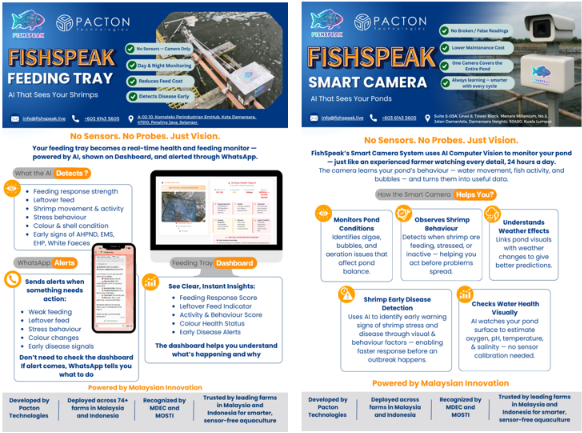
The platform has also attracted support from scientific and institutional partners. WorldFish/CGIAR has been engaged as a scientific validation partner, while other institutional collaborators include MDEC, MRANTI, KPKM, Agrobank, UTM, UPM and UPSI. The platform filed three Malaysian patents and the next-generation Shrimp Early Disease Detection (SEDD) module — which relies on computer vision rather than fixed sensors. These developments demonstrate that corporate–startup collaboration in Malaysia, when paired well, produces quality outcomes.