
1. Malaysia’s Ongoing Efforts in the Metaverse Space
Malaysia is exploring immersive technologies, particularly the metaverse, as part of the country’s digital transformation strategy. One of the initiatives is the IP360 Metaverse Platform, launched by the Malaysia Digital Economy Corporation (MDEC). This browser-based 3D environment brings together the nation’s rich cultural assets and intellectual properties, showcasing them globally, allowing local creators and institutions to showcase Malaysian heritage and storytelling on a global stage. Alongside this, the “Business in Metaverse” programme is helping 200 small and medium-sized businesses develop their own virtual storefronts and brand experiences, enabling them to participate in emerging digital economies.
Malaysia is exploring immersive technologies, particularly the metaverse, as part of the country’s digital transformation strategy. One of the initiatives is the IP360 Metaverse Platform, launched by the Malaysia Digital Economy Corporation (MDEC). This browser-based 3D environment brings together the nation’s rich cultural assets and intellectual properties, showcasing them globally, allowing local creators and institutions to showcase Malaysian heritage and storytelling on a global stage. Alongside this, the “Business in Metaverse” programme is helping 200 small and medium-sized businesses develop their own virtual storefronts and brand experiences, enabling them to participate in emerging digital economies.
The physical infrastructure needed to support these experiences is also expanding. With Digital Nasional Berhad’s 5G rollout now covering 82% of populated areas in Malaysia, Malaysia is rapidly enhancing its ability to deliver low-latency, high-bandwidth immersive services. At the state level, Air Selangor’s partnership with Schneider Electric brought Malaysia’s first utility-level virtual digital twin at Semenyih 2 Water Treatment Plant. Likewise, Kuala Lumpur City Hall (DBKL) is also developing a virtual twin of the capital for better urban planning and faster emergency response.
2. How Other Countries Are Making It Work
There is now a clear pivot away from entertainment-driven use cases toward practical applications in industry and public services delivery.
South Korea’s “Metaverse Seoul” virtual platform lets users access public services and cultural sites, part of a US$200 million digital strategy, in alignment with South Korea’s Digital New Deal. By 2026, South Korea aims to achieve the fifth-largest metaverse economy market globally. In Shanghai, city-wide digital twins help simulate emergency response and infrastructure planning. Meanwhile, Dubai’s Metaverse Strategy targets the creation of 40,000 virtual jobs and US$4 billion in GDP impact, and is backed by policy innovation via its DIFC Metaverse Platform.
ASEAN neighbors like Singapore and Thailand are also advancing their own metaverse agendas. In Singapore, Virtual Singapore has integrated digital twin planning as part of the broader Singapore Smart Nation 2.0 agenda which enables real-time, interactive simulations for urban development and policy testing. Meanwhile in Thailand, Thailand’s Securities and Exchange Commission (SEC) has introduced a regulatory sandbox that offers both local and international digital asset providers a safe, time-bound environment to test services without the need for full licensing, creating room for innovation under guided oversight.
These are not experimental side-projects - they’re part of national digital transformation strategies.
3. Friction Points on the Path Forward
Despite growing momentum, public perception of the metaverse remains sceptical and it’s not hard to see why. Once hailed as the next evolution of the internet for education, retail, and entertainment, it quickly lost credibility and rode a brutal hype cycle. Yet the potential remains substantial. By tackling three key challenges, Malaysia can position itself alongside leading nations shaping the future of the metaverse.
Data integration and interoperability remain as major constraints. Building real-time digital twins or immersive simulations requires seamless access to clean, structured data. However, many agencies and private sector systems still rely on fragmented legacy infrastructure, making it difficult to connect and standardise data streams from Internet of Things (IoT) devices, Geographic Information System (GIS) platforms and operational systems.
At the same time, technical readiness across the ecosystem is still uneven. While government agencies and universities are laying important groundwork in this aspect, the talent pool for spatial computing, immersive system design and simulation engineering remains limited. There is also a persistent perception challenge: the metaverse is still largely seen as entertainment-first. This misconception slows down adoption in sectors like city planning, healthcare and education.
Legal and policy frameworks, too, have yet to catch up. Malaysia’s Personal Data Protection Act (PDPA) and existing cybersecurity policies offer a baseline, but they were not designed for persistent virtual environments. As the lines blur between digital and physical spaces, questions around data ownership, virtual identity and user protection are becoming more complex.
4. Charting the Way Forward

To move beyond pilots and unlock real value, Malaysia needs a clear plan for the metaverse. This should outline focus areas for application while setting shared data standards, cross-sector roles and governance structures.
Alongside this, a public sandbox could allow startups, agencies and educators to test metaverse tools in a controlled setting. It could also serve as a governance lab for experimenting with digital credentials, platform safety protocols and virtual identity standards.
Corporate players have a vital role to play. Conglomerates building smart townships, banks expanding digital services and telecommunications providers scaling 5G infrastructure can all co-invest in these test environments, offer live use cases, or even second talent to co-develop frameworks, aligning corporate innovation with national priorities.
At the same time, growing the talent pool will require cross-border collaboration and capacity-building. Malaysia’s universities and technical institutions can build joint labs and host international bootcamps with leading firms in the areas of spatial computing and simulation which will fast-track the readiness of Malaysia’s metaverse workforce.
Finally, Malaysia is well-positioned to lead regional efforts. By facilitating shared ASEAN use cases, such as immersive cultural heritage showcases or regional disaster simulations, the country can demonstrate how metaverse technologies can serve collective regional needs. ImaginASEAN, which launched cultural simulations on platforms like Roblox, have already proven that youth-driven metaverse storytelling can be scaled regionally with institutional support.
5. Closing Reflections
During the Energy Transition Meeting in ASEAN: Fostering Regional Cooperation co-hosted by the World Economic Forum’s Centre for Energy and Materials and the Malaysia Centre4IR (MYCentre4IR), the Deputy Prime Minister of Malaysia took part in an Extended Reality (XR) experience that visualised the complexities of energy transition. This interaction sparked a direct conversation on how such technologies could be adopted.
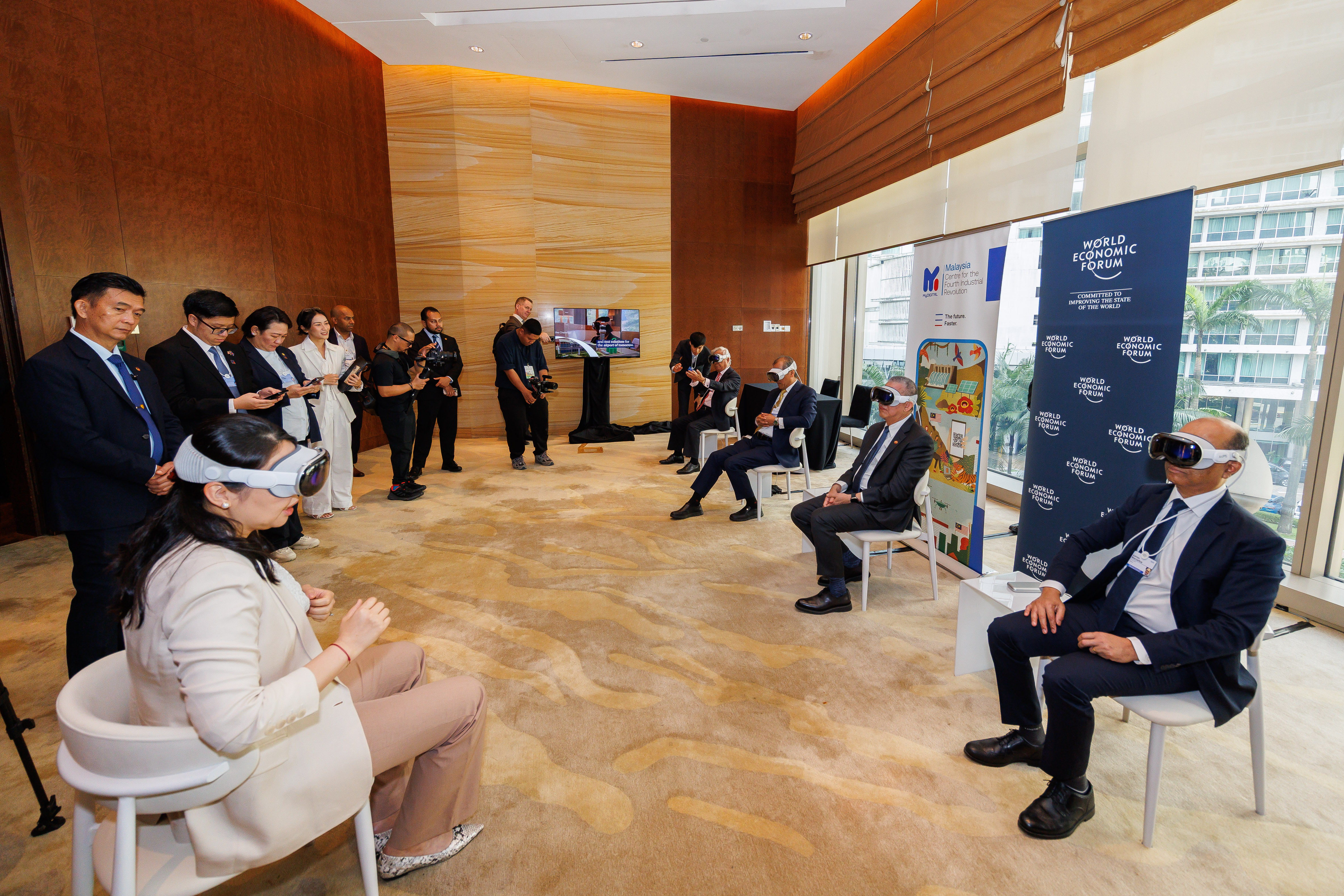
The Metaverse that was initially introduced to the world has now evolved. There is a need to shift perspectives of how it can be used to reimagine industry, public services, education, and policymaking. With foundational infrastructure in place and cross-sector initiatives already in motion, Malaysia has the necessary assets to leverage it as part of the country’s national digital transformation efforts.