Energy Markets
When geopolitical conflict risk rises, markets don’t wait for production outages. The quickest shock channel is logistics: shipping availability, war‑risk insurance, port congestion, and the reliability of chokepoints. For ASEAN and Malaysia, that means higher volatility can show up as delayed cargo and higher delivered costs, feeding directly into inflation, margins, and investment decisions.
Why chokepoints now drive “macro” outcomes
The recent geopolitical conflict has disrupted certain trade routes. Roughly 20% of global crude oil and Liquefied Natural Gas (LNG) transfers, and about 30 to 35% of global Liquefied Petroleum Gas (LPG) exports, which are critical feedstocks for petrochemicals, have been disrupted.
Adding to this vulnerability is the severe physical toll on energy infrastructure. Recent assessments indicate that energy infrastructure repair and restoration costs of affected Oil & Gas (O&G) facilities could reach at least US$25 billion, significantly impacting critical LNG facilities and refineries. Recovery is defined by structural constraints rather than just capital. For example, severe backlogs for large-frame gas turbines driven by global data center electrification and clean energy demands mean full facility restorations could take up to five years. This prolonged disruption pushes pre-crisis production capacity further out of reach, embedding long-term volatility into fossil fuel markets.
Adding to this vulnerability is the severe physical toll on energy infrastructure. Recent assessments indicate that energy infrastructure repair and restoration costs of affected Oil & Gas (O&G) facilities could reach at least US$25 billion, significantly impacting critical LNG facilities and refineries. Recovery is defined by structural constraints rather than just capital. For example, severe backlogs for large-frame gas turbines driven by global data center electrification and clean energy demands mean full facility restorations could take up to five years. This prolonged disruption pushes pre-crisis production capacity further out of reach, embedding long-term volatility into fossil fuel markets.
The Pivotal Role of the Energy Transition
These geopolitical shocks highlight exactly why the clean energy transition plays a pivotal role in economic resilience. Electricity generated from wind and solar is largely insulated from fossil fuel price volatility. Once these facilities are built, the supply is essentially free. While the current crisis poses short-term supply chain challenges for clean energy infrastructure such as disruptions to the transport of metals needed for solar panels, the long-term imperative to reduce reliance on volatile oil and gas markets has never been clearer. For ASEAN, accelerating the transition to clean energy is not just a climate goal, but a fundamental security and economic strategy to shield local economies from global energy shocks.
Petrochemicals and Polymers: Volatility and Concentration Risk
In petrochemicals, the near-term issue is often not plant shutdowns but rising logistics costs and longer cash cycles. Very Large Crude Carrier (VLCC) tanker rates for certain routes to East Asia have increased phenomenally by 138% to around USD48,000 per day, with marine insurance premiums up by more than 60%, alongside longer port turnarounds and paperwork delays. The practical result is higher delivered feedstock costs, tighter procurement timelines, and a shift away from spot buying towards contracts that price certainty of supply.
Polymers add another fragility point: trade concentration. A key gateway for global polymer exports has faced downtime, so disruption can cascade through regional availability. Price volatility can overshoot physical shortages because inventory buffers are often only 30 to 60 days. If risks persist beyond buffers, buyers restock defensively and the spot market tightens fast.
Importantly, rerouting is not frictionless. Alternatives can add meaningful lead time (often a week or more) and that scaling substitute export handling elsewhere could take 18 to 24 months. So, reliability, not just price, becomes the scarce resource in the next 6 to 12 months.
Spillovers: oil and metals reprice the whole industrial stack
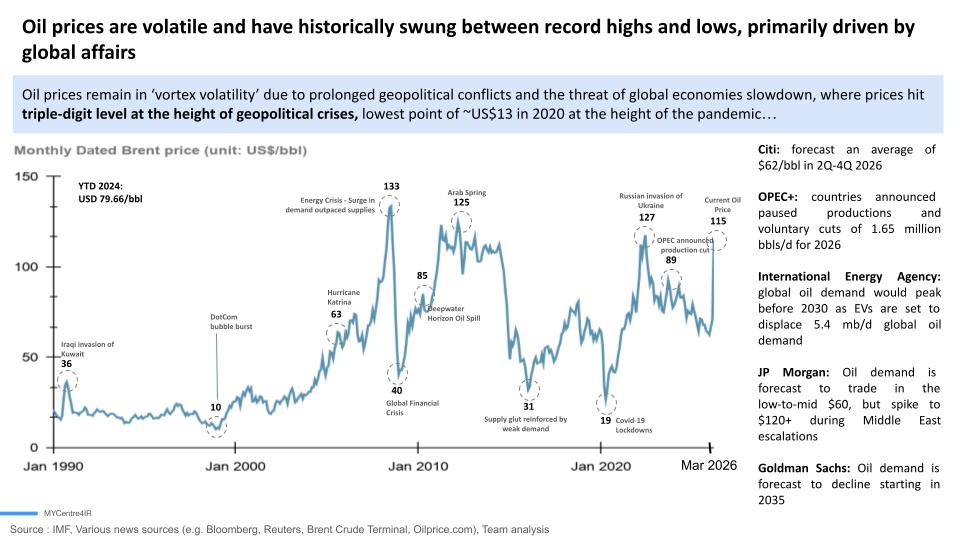
The same chokepoint logic ripples into oil. Based on JPMorgan’s tail-risk framing: oil could surge towards US$120/bbl if disruption becomes sustained.
And the shock doesn’t stop at energy, materials are also similarly impacted. Aluminium is a highly route-sensitive key raw material. About 9% of global aluminum production were recently affected by the recent trade route disruptions causing certain producers to scale back or shutter operations. Consequently, key Asian markets are experiencing severe supply squeezes, pushing aluminium premiums to an 11-year high.
For ASEAN’s export-oriented base (electronics, automotive components, construction materials), this translates into input-cost volatility and working-capital pressure; when shipping risk rises, prices can jump and downstream manufacturers feel the squeeze.
For ASEAN’s export-oriented base (electronics, automotive components, construction materials), this translates into input-cost volatility and working-capital pressure; when shipping risk rises, prices can jump and downstream manufacturers feel the squeeze.
Building Malaysia’s Resilience
As the global supply chain shifts from a focus on speed to a focus on assurance, Malaysia has a unique opportunity to respond and reflect on building its domestic resilience. By developing sophisticated infrastructure for strategic reserves, responsive inventory management, and comprehensive risk-mitigation services, Malaysia can play a key role in supporting the flow of essential goods across the region.
For Malaysia in the long term, a commitment to reliability will encourage "produce-near-demand" investments. This shift allows Malaysia to integrate more deeply into downstream manufacturing and circular economy infrastructure, ensuring that our industrial ecosystem is both sustainable and robust.
To achieve this, Malaysia can leverage two primary levers:
(1) Digital Intelligence: Implementing AI-enabled monitoring for freight, insurance, and port congestion allows for predictive rather than reactive responses.
(2) Workflow Optimisation: Modernising documentation and customs workflows to compress response cycles from weeks to days, ensuring that supply chains remain fluid even during disruptions.
How the Transitioning Industrial Cluster (TIC) Can Support Resilience Building?
The Transitioning Industrial Cluster (TIC) as a multi-stakeholder collaboration mechanism has the potential to enable Malaysia and ASEAN to respond to shocks such as energy and logistics disruptions as a coordinated system rather than isolated entities. The core of TIC is in its goal to convene and align government (policy levers, permitting, catalytic funding), industry (demand signals, operational execution, site access), financiers/Development Financial Institutions (bankable blended financing), and technology partners (industrial symbiosis tech stack for visibility and matching) so their resources become complementary and their actions are sequenced.
Applying the TIC framework to the current context, TIC would enable rapid pivoting of trading and sourcing, switching suppliers, rerouting export/import pathways, and reallocating intermediate products across firms by institutionalising industrial symbiosis (shared utilities, by-product exchange, substitute inputs, pooled storage, and coordinated procurement) and deploying an industrial symbiosis tech stack (real-time material/energy flow mapping, digital measurement, reporting, and verification (MRV), demand–supply matching, inventory visibility, and scenario stress-testing).
In practice, this translates to clusters
(1) pre-agreeing response playbooks and trigger thresholds (e.g., price spikes, shipping disruptions);
(2) maintaining a live registry of critical inputs, alternatives and local/regional substitutes;
(3) activating fast-track protocols for shared storage, shared transport, and shared energy resilience measures; and
(4) using the symbiosis platform to match underutilised capacity and by-products to firms facing shortages. This would enable the cluster to continue operating, protecting jobs, stabilising costs, and preserving export competitiveness even when global trade routes and energy markets are disrupted.
The TIC framework enables the development of industry ecosystems that are intelligent and adaptable, building resilience and reliability at scale in a world increasingly faced with systemic shocks.